Dear ,
I hope you are all well. Over the last three weeks, I’ve been
enjoying the school summer holidays, hanging out with my kids, playing lots of soccer and tennis on the local park. One of the main reasons why I love playing soccer and tennis is because I can spend time looking at the trees and the fields and sky and take in the isness and beauty of my surroundings. I’ve always been in love with the sky - especially the different forms of clouds and the glorious shades of sunlight passing through them as the sun starts to go down in the evening. I’ve often
thought that sky-scapes can be as beautiful as any landscape. And the best thing is, they are completely open to us all the time! That is, we don’t have to travel out of the city to a beauty spot, all we have to do is lift our eyes above the ground. (Hmmm, there might be the beginnings of a poem in that.)
We’ve had a few trips with the kids too, including a very enjoyable weekend at a Science and Music
Festival called Bluedot, which is held every year near Manchester in the UK. We went along because I took part in a debate on 'Is War inevitable?' with two other academics. It wasn’t an argumentative debate though, because we all had roughly the same point of view: that war isn’t inevitable. My perspective is that war can’t be inevitable because it hasn’t always existed. As I showed in my book The Fall (and as a lot - perhaps most - of anthropologists and archaeologists would now agree), there
was an extended period of prehistoric peace before the advent of farming and civilisation, which means that war has only existed for about 5% of the human race’s tenure on his planet.
There was some great music at the festival. One of my highlights was when I joined the queue at the artist's cafe and found myself standing next to Wayne Coyne, the singer one of my favourite bands, The Flaming Lips. I had a chat
with him and he was lovely and friendly. I told him that I saw his band in Manchester 20 years ago and it was still one of my best ever gigs and he was very pleased. How great it is to meet people you admire and find that they are nice human beings!
The scientific aspect of the festival was also interesting, partly because I was very aware that there was a dogmatic aspect to it. I was aware of a shared belief
system, which you could call ‘scientism.’ This is the worldview of materialist science, which believes that matter is the primary reality of the world, that the mind is just a product of the brain, that human beings are just genetic machines, that free will and the sense of self are illusions, and so on. Like all belief systems, scientism defines itself through opposition - in this case, opposition to religion and the supernatural. There were a couple of events at the festival (one a dialogue
with the arch materialist Richard Dawkins) where “supernatural” phenomena like telepathy and homeopathy were mentioned, and the audience practically booed and hissed. The second event was a talk about a very interesting field called quantum biology (which I write about in my new book Spiritual Science), which explains mysterious biological phenomena (like bird migration and enzyme reactions) in terms of weird quantum principles such as entanglement and “quantum tunnelling.” These ideas are very
mysterious and speculative - there is actually a lot more empirical evidence for things like precognition and telepathy. So this made it very clear that there was a kind of dogmatism at work.
It was also very interesting to see Richard Dawkins in person. He was quite stuff and humourless, although quite an interesting speaker - mainly because he was so outrageously scathing (using swearwords that my kids have
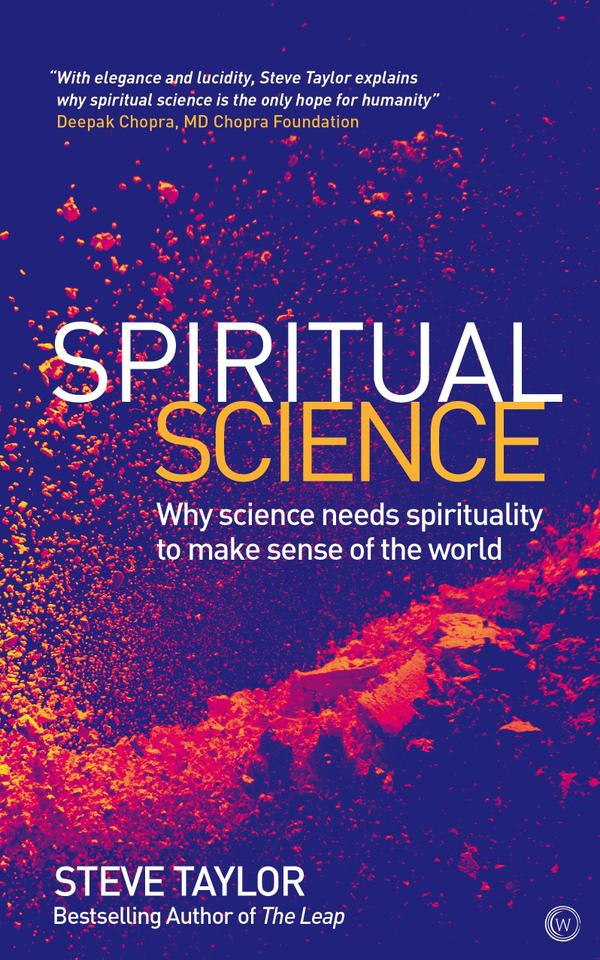
hopefully never heard me use) to anyone who disagreed with him, or expressed sympathy for religion. I see him as a scientific fundamentalist, who closed his mind long ago. The rigidity of his belief system was expressed in the stiffness of his body language. All of this is very relevant to my new book Spiritual Science. One of its aims is to examine the belief system of materialism, to identify its tenets, and show how it developed. But most of all, I show that materialism is
completely inadequate as a model of reality, since there are so many things it can’t account for - such as consciousness, the influence of the mind over the body, psi phenomena, near-death experiences, spiritual experiences, and even evolution and the origins of life. So I put forward an alternative spiritual view of the world which can explain all of these phenomena.
The book is officially published
in mid-September, but should be available to buy in a couple of weeks. You can order on the links below: Events
I have a few events planned over
Sept-Oct-Nov to tie in with the publication of the book.
I also have a one day workshop in Glastonbury on Saturday 27th October, in the Avalon room at the Glastonbury Experience. This is not specifically related to Spiritual Science, but is entitled ‘Five Steps toward Spiritual Awakening.’ If you’re interested in attending, let me know at [email protected]. The cost is £45.
Conferences On the weekend of 14-16th September 2018, I’m one of the keynote speakers at the British Transpersonal Psychology Conference, at the University of South Wales (in Newport). The title of my address is ‘Moving Beyond Materialism.’ If you would like to attend the conference, you can book here.
On the weekend of 8-11th November, I’m speaking at the Eckhart Tolle Foundation conference in Huntington Beach, California. If you’re interested in attending, take a look here. The Mindful Mann Festival
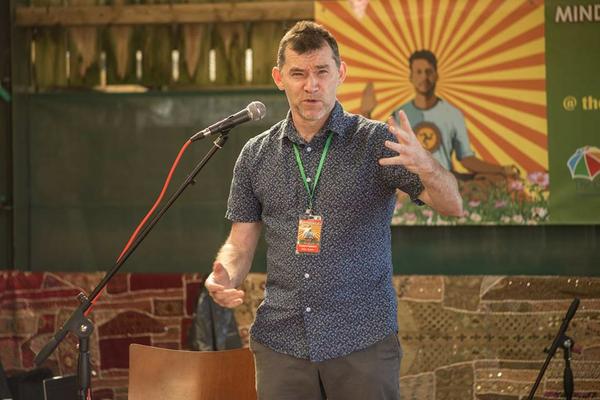
Here’s a photo I received of me speaking at a festival on the Isle of Man a few weeks ago. I look like I’m launching into a song. I don’t recall the audience walking out, so I’m sure I didn’t sing!
You can watch the whole talk I did there, including readings of poems and some guided meditations on Youtube here. Poem
Thanks to those of you who responded to the batch of poems (or poetic reflections - since you might not think of them as poems, strictly speaking) I sent out a couple of weeks. I really enjoyed reading your comments about them! I’ve been writing a lot of poetic reflections recently, so let me end this newsletter with another. But first, a little introduction:
The philosopher Heidegger said that human beings' main problem was the 'forgetfulness of human existence.' He meant that we tend to take life for granted, to forget about the sheer strangeness of being in the world, and the wonder and is-ness of the world around us. I think he was right - once you stop taking life for granted and become
of its strangeness and wonder, then you can't be bored or depressed. You live in a continual state of amazement. That's how I feel. I find life so strange and exhilarating that I feel like I'm on a permanent holiday (or vacation, in US English). And this poem is an attempt to describe that.
The Newness
I’ve lived here for 15 years now -
I’ve walked the same streets every day,
and seen the same buildings, the same trees, the same sky -
but my eyes are still open wide with
wonder,
there’s still so much strangeness around me.
This morning, like so many other mornings,
I buy my newspaper from the local shop, and cross the road.
And I’m struck by the perfect geometry of the houses
with their sloping roofs and the jigsaw of endless
layers of bricks.
I’m struck by the patterns of shadows stretching across the pavement
thrown by railings and gates and fences.
I’m struck by the reflections flashing from the windows of parked cars -
and then, above me, by the waves and spirals of cloud formations
that have never been seen before and never will be seen again.
Why should the familiar become mundane?
As long as my senses are keen and eager, like a hunter’s,
and as long as my mind is clear and quiet,
like a fisherman’s as he waits and watches,
then reality will keep refreshing and reconfiguring itself.
Every moment will arise as a new born world,
without reference to the past.
All best wishes and blessings, Steve
|
|
|
|