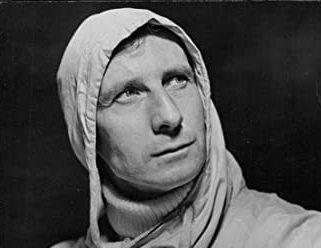
Soon after the outbreak of the Second World War, the Scottish soldier Bill Murray was sent to North Africa, where he was captured by German soldiers in 1942. He spent the three remaining years of the war in prison camps. Before the war he had been a keen climber in the Scottish High-lands, and decided to spend his empty hours in the camp secretly writing a book about his climbs,
on the camp’s hard and coarse toilet paper. The act of reliving all his climbs, step by step, and describing them in writing lifted him above the deprivation and suffering of the prison camps. As he put it, “I learned from sheer necessity to live in the mind rather than the body.” He had nearly finished the book when he was moved to a different prison camp. He hid the wads of toilet paper in his coat, but they were discovered and confiscated, and he never saw them
again.
There was a library at the new camp, and although he was depressed about the loss of his book, Murray devoted himself to reading, particularly psychology and philosophy. One morning a young British officer came up to him in the compound and said, “I’ve seen you around the last day or two…It seems you’re ready to start on the Mystic Way. Would you like me to give you instruction?”
Murray wasn’t sure what he meant by the term ‘Mystic Way’ but agreed to meet the next morning.
Shortly afterwards, feeling slightly dazed by the meeting, Murray had a powerful awakening experience. As he described it in a memoir he wrote towards the end of his life:
As I climbed upstairs, to the dormitory, I became aware of an extraordinary sense of joy. It suffused mind and body...I had stepped out of time into timelessness…I remember seeing through the windows the barbed wire fence with its sentry towers, and the prisoners in the compound, all and each transfigured by a beauty that glowed through them, engulfing all as if from another
place.
When he met the officer the next morning, he was introduced to a group of half a dozen other soldiers who were following the mystic way, and they formed a study group, meeting regularly to dis-cuss spiritual texts and ideas and to practise meditation. Although he had never been aware of spirituality before, Murray recognised that he had had the kind of experience that mystics such as
Plotinus and St. John of the Cross described. Despite the physical suffering of the camp, and the uncertainty of his survival, he felt invigorated and elated.
Not long after his awakening experience, Murray wrote letters to his family, saying that he was "happy and thoroughly well." Unable to believe that he could be happy in such circumstances, his family thought he must have gone mad, but he reassured them: "I have not lost my reason, but all worries, anxieties and frustrations." He described experiencing "an undivided mind, inner
stillness, self-realisation, and a fullness that I never believed possible."
His new positivity encouraged him to rewrite his mountaineering book, even though there was a high risk that it would be discovered and lost again. As conditions worsened at the camp during the final period of the war, he and the other inmates were close to starvation, but he managed to finish the book. Exhilarated by his creativity and his spiritual studies, he wrote that “During
this last year, I had not once thought of myself as imprisoned.”
Against all odds, both he and his book survived the war. He returned to the Scottish mountains to recover from his ordeal, and seriously contemplating joining a monastery. However, his book ‘Mountaineering in Scotland’ was accepted by a publisher, and he realised that he had a new career as an author.